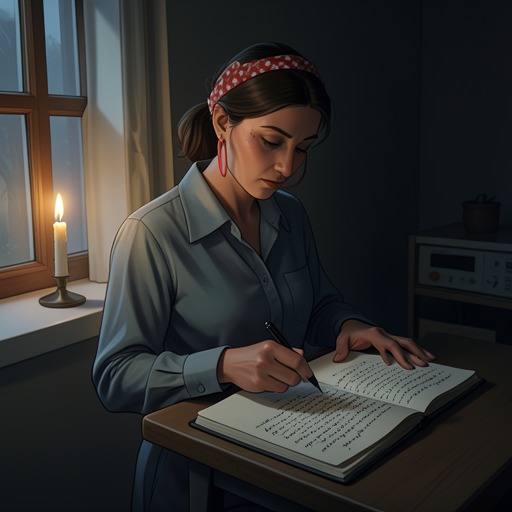
Shug falls in love with Germaine and leaves Celie
The Color PurpleShug Avery’s new love for Germaine turns an intimate confidence between Shug Avery and Celie into a painful parting. In a letter to Nettie, Celie recounts how a lighthearted fortune-cookie reading gives way to Shug’s confession: she has fallen for a nineteen-year-old musician in her band and wants six months to pursue him. Celie answers with both enduring love and a boundary—she cannot stay—and Shug leaves when someone arrives at the door.
The Disclosure
The episode begins against the history of Celie’s absence and return. Celie explains that she had spent the previous summer fixing up the house, hoping it would be ready if Nettie came soon. She has made it comfortable and found a woman to live there and look after it; after that, Celie says, she came home to Shug Avery. The house thus holds a practical sign of Celie’s hopes for family and homecoming just as Shug reveals a desire that unsettles her own shared life with Celie.
At first, the news arrives indirectly, through fortune cookies. Celie reads a prediction that her future looks happy and bright, laughs, and passes the paper to Shug Avery. Shug reads her own fortune slowly, as if afraid of what it might say, then reports that it says she has the hots for a nineteen-year-old boy. Celie does not immediately understand that Shug is speaking about an actual relationship. Her surprise is sharpened by her own lack of interest in men: she has not thought about boys in a long time and has never thought about men that way.
Shug Avery explains that the relationship began the previous year, when she hired Germaine to work in her band. He could play only the flute, an instrument Shug initially thought unlikely to suit blues music. Hearing him changed her mind: she recognized that blues music had been missing precisely what his flute could provide. The attraction is therefore introduced alongside his musical place in the band, rather than as a romance detached from Shug’s working life.
From Confession to Conflict
As Shug Avery describes Germaine, her account becomes an extended, excited praise of his appearance and manner. She calls him little and cute, admires his dancing feet, and lingers over his honey-brown curly hair. The accumulating detail makes Celie’s hurt visible: Shug is sharing the sort of intimate enthusiasm she has usually brought to Celie, but the new beloved is its subject. Celie interrupts her with a plea to stop, saying Shug is killing her. Shug halts mid-praise; her eyes fill with tears and her face crumples. She apologizes, explaining that she had been longing to tell somebody and that Celie is usually the person she tells.
Shug locates the change in the time Celie spent away from home. She says she missed Celie while Celie was down home and describes herself as a high-natured woman. Celie’s response is not another spoken argument: she takes a piece of paper used for cutting patterns and writes a terse note telling Shug to be quiet. The sewing-pattern paper makes the exchange concrete and private, while its blunt message registers how little Celie can bear to hear more about Germaine.
Shug then tries to explain what the relationship means to her. She presents herself as getting old and fat, and says that nobody thinks she is good-looking anymore except Celie—or so she had thought. Germaine’s age becomes part of her appeal and part of her uncertainty: he is nineteen, and Shug wonders how long the relationship can last. She says that she does not take men seriously, even though some can be fun, and asks Celie for six months for what she calls her last fling. She promises to try to make their life together as it was afterward. The request exposes the unequal terms of the proposed arrangement: Shug asks Celie to wait through a relationship that she herself describes as temporary, while Celie is already experiencing the loss in the present.
Love and Departure
Shug Avery asks whether Celie loves her while kneeling beside her and crying. Celie’s answer is unambiguous: she loves Shug, whatever happens and whatever Shug does. That declaration does not resolve the conflict. Celie immediately says she cannot stay there. Shug protests that Celie is her friend and says she is frightened: Germaine is a third of her age, a third of her size, and a third of her color. She tries to laugh while predicting that he will hurt her more than she is hurting Celie, but still asks Celie not to leave.
The scene ends without a negotiated reconciliation. The doorbell rings; Shug Avery wipes her face, goes to answer it, sees who is there, and continues out the door. Celie soon hears a car drive away. The passage does not name the visitor in that moment, but places Shug’s departure directly after her plea for six months with Germaine. Celie goes upstairs to bed, and sleep remains out of reach that night. The departure gives physical consequence to the separation Celie has just announced, while the sleepless ending leaves its immediate emotional cost unresolved.
Letter Form and Significance
Celie tells the episode in a letter to Nettie, framing the painful disclosure as something she must report to her sister. The letter preserves the scene’s shifts in register: a fortune-cookie joke, Shug’s animated description of a musician, Celie’s written rebuff, tears, a plea for time, and the sound of a car leaving. The contrast between the cheerful fortune about a bright future and Celie’s broken heart gives the opening its irony. Her expectation that the house would be ready for Nettie and her return to Shug’s home life are followed not by the secure future she imagined, but by Shug’s request to pursue another relationship.
The episode does not cancel Celie’s love for Shug Avery; it distinguishes love from consent to the arrangement Shug proposes. Celie can affirm her attachment and still refuse to remain in the house while Shug takes six months for Germaine. Shug’s distress and her appeal to their friendship complicate the parting, but do not erase Celie’s decision. The final movement—from the doorbell to the departing car and Celie’s sleepless night—makes separation an action, not merely a fear voiced in conversation.